

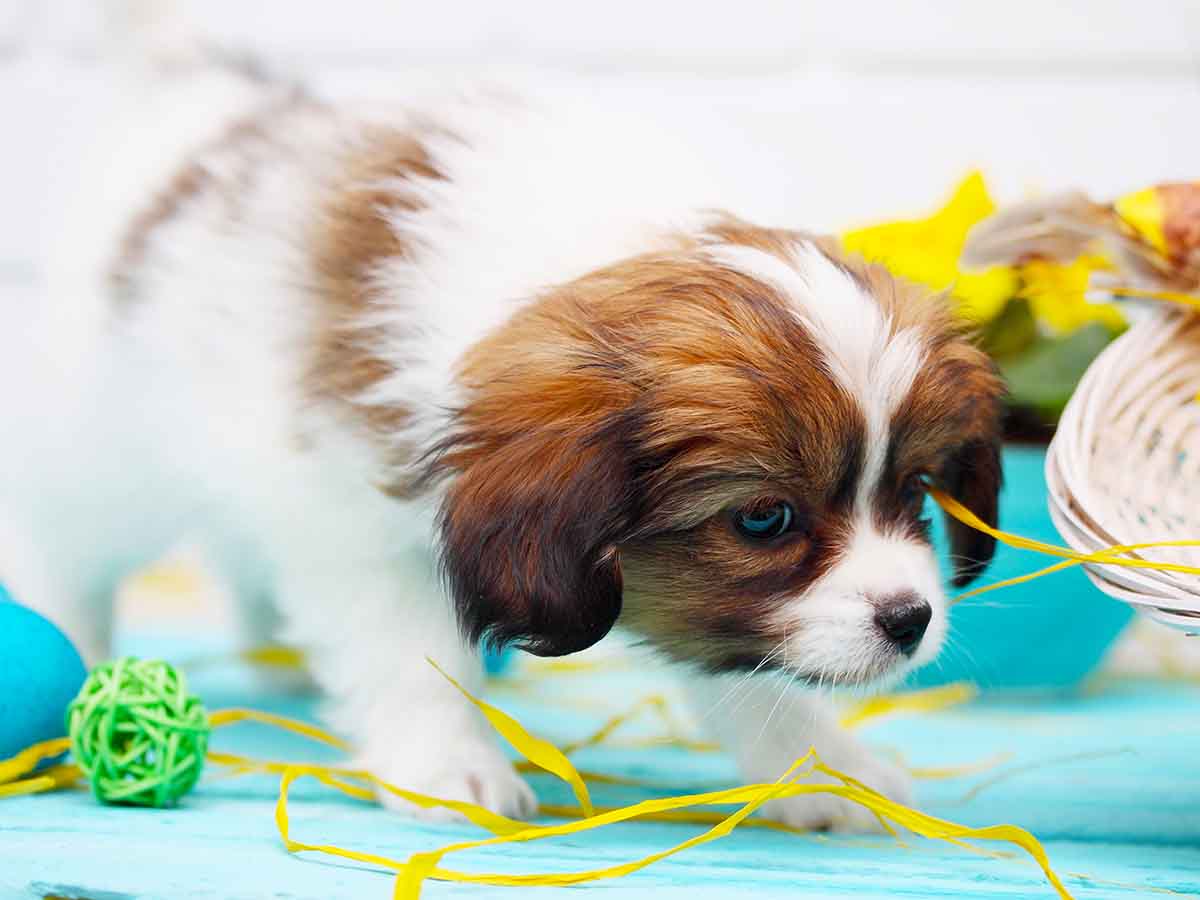
What a Puppy Can (& Cannot) Smell: 11 Answers Revealed
Everyone knows that scent is where dogs excel.
Scent in a dog’s nose is practically a superpower, and a dog’s willingness to work with a human handler means dogs help with search and rescue, law enforcement, and medical science.
But what about your cute puppy?
Is that bundle of fur and mischief already a scent superhero?
1. When Does Your Puppy Develop a Sense of Smell?
Your puppy is born blind with its eyes tight shut, but its nose is fully functioning – with a sense of smell and heat detection. It doesn’t have any experience, but its nose means it will navigate to its mother and her milk despite being blind.
Human babies (and their mothers) recognize each other by scent, but a puppy’s scent sense is far better. Plus, your puppy retains its high scent awareness through adulthood.
Experience builds the association through scent and its meaning.
2. How Does Your Puppy’s Nose Work?
Both you and your puppy have sense receptors in your noses.
You have around 5 million, and some puppy breeds have over 100 million. A Bloodhound has approximately 300 million scent receptors, and a bloodhound’s capacity to follow a scent trail is legendary.
The scent receptor cells are unique – they are neurons, and there are hundreds of different types, each able to interact with varying molecule sizes.
The human brain is hardwired for scent, but your puppy has more of its brain (about an eighth) devoted to interpreting scent than you do. The area of a puppy brain devoted to scent recognition is much larger (proportionally) than the portion of your brain that processes visual images.
This enhanced capacity for smell means your puppy interprets multi-layered complex scents.
You may smell chocolate in a hot drink, but your pup can smell every ingredient in that cup.
Plus, your puppy retains scent signatures for years.
3. Why is Your Puppy’s Nose Wet?
Before you got your puppy, you may have heard that a cold, wet nose is a sign of good health in dogs.
The damp nose helps the puppy’s nose process scents more effectively. A wet nose means the puppy is functioning normally and healthy.
4. How Can You Help Your Puppy Develop a Keen Sense of Smell?
Some breeds like herding and hunting dogs are better at processing scent information.
Short-nosed dogs (bulldogs) have less room to process scent than other breeds and are less effective than scent hunters at recognizing familiar smells.
All puppies enjoy using their noses – it is their best way to experience the world – allow your pup plenty of time to sniff the trails left by other animals and dogs.
The world through a puppy’s nose records everything that happens in your street or park. Your pup will soon recognize the 10-year old Labrador with a taste for chicken that has a walk at 7.00 am, without ever meeting him in person.
Puppies enjoy games where they hunt for a treat using their sense of smell, and when they get older, you can take part in sports that use a scent trail for you and your puppy to enjoy a run.
5. Can a Puppy Smell if You Are Pregnant?
Your puppy learns to distinguish you as an individual by your unique scent signature.
Pregnancy changes your scent signature by:
- Putting your sweat glands into overdrive.
- Giving you bad breath.
- Enhanced blood supply changing your body PH.
- Hormonal changes.
Your puppy will certainly notice the changes in your scent signature but lacks the experience to understand what it means.
6. Can Your Puppy Smell if Someone Has a Period?
Blood has a distinctive smell, and in the case of a period, it is precisely located.
Most puppies will instinctively greet you and other people by trying to smell your crotch, as that is the area where most scent concentrates.
Puppies don’t shake paws with each other; they sniff instead. They tend to sniff the rear end because this is where all the interesting scents concentrate.
A puppy’s nose is sensitive, the smell of blood is strong, strong odors excite puppies as they build their scent library of experience.
Your puppy can certainly smell if someone in the room has a period.
However, you can train your puppy not to approach humans offensively and keep their sniffing to a safe, polite distance.
7. Can Your Puppy Smell Breast Milk?
Breast milk has a unique scent signature. Your puppy will recognize a new scent signature and file it away as a thing it has smelt.
Colostrum (an ingredient in breast milk) smells sweet, and humans are as sensitive to it as much as puppies. Your puppy may tag the smell as potentially edible and attempt to track down the source of the delicious scent.
Your puppy’s sense of smell exceeds yours, and it can detect the scent of breast milk at levels of a stray drop that won’t register on human awareness.
Your puppy doesn’t understand that it is smelling breast milk; it notices a new scent and seeks the source.
8. Can Your Puppy Smell Fear?
All emotions have a scent, and humans react to the chemical smell produced by others.
If your puny human nose can scent if your friend is happy or fearful (subconsciously), then your puppy’s super-smelling sense can read your emotional scent loud and clear.
Part of your puppy’s learning will be to associate the scent of your fear with actions. Fear has a hefty dose of adrenalin (flight or fight response), and a puppy (and other animals) soon learn to understand this scent.
Fear is an unsettling scent for your puppy because it implies that there is something to be afraid of in the area.
When your puppy is an adult, it may start to defend you by growling and barking if it scents fear in your presence.
9. Can Your Puppy Smell Cancer?
Cancer and other diseases have a unique chemical and scent signature. Medical scientists are working with dogs to create better diagnostic tools for these diseases.
Selected dogs train to indicate when they smell the chosen condition. Dogs’ noses are sensitive to scents in parts per trillion, and a trained dog is exceptionally good at early detection.
Your puppy is capable of smelling cancer and other diseases, but it is not capable of working out what it means or telling you about it.
The cancer smell is one in thousands of scents signatures it encounters. It doesn’t have an importance to the puppy other than existence.
10. Do Puppies Recognize Their Mothers Through Smell?
The first dog scent signature your puppy identifies is its mother, closely followed by its littermates.
In your memory, you have a visual record of people’s faces.
In your puppy’s memory, it has a scent library of unique dog signatures. Not only does your puppy remember its mother and recognize her years later, but also every other dog it has met.
A puppy’s scent identification tells the puppy that this scent is a unique individual, how long ago they met, and if they were more or less dominant than the puppy.
11. Are There Any Bad Scents for Your Puppy?
Most puppies don’t like citrus smells – some exceptions love the scent of a freshly peeled orange, but the majority hate it.
Your puppy is likely to find your lemon-fresh cleaner distasteful, and if you use citrus aromatherapy oils to scent your home, you are traumatizing your pup as much as if you were living next to a pig farm.
Hot chili peppers cause a painful reaction to your puppy’s supersensitive nose. You experience a tingling sensation from the spice, but the effect on your puppy smelling a chili is worse than that and can cause respiratory issues in sensitive pups.
Most puppies will avoid strong chemical cleaners, perfume, and products like nail varnish.
The downside of having a supersensitive nose is that you can easily become overwhelmed by strong odors.
Conclusion
Your puppy has a marvelous sense of smell that allows it to recognize you, other dogs, another human, and even the neighborhood cat.
Your pup can use scent for navigation, communication, tracking, or simply exploring a new field.
Your puppy’s nose is its not-so-secret superpower.