

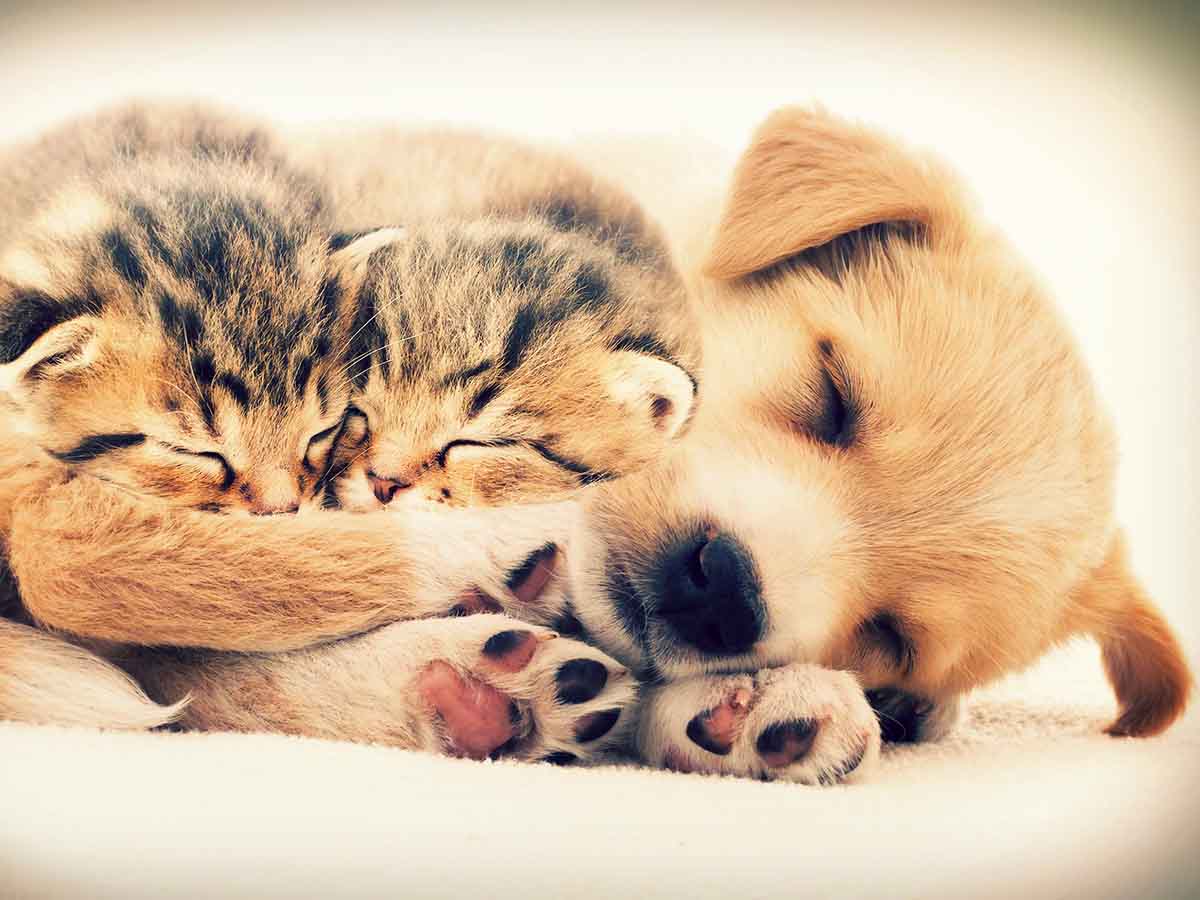
Get Kitten or Puppy First? 3 Scenarios Explained (Pros + Cons)
Some people are dog people, and some people are cat people, and some like both equally.
Although most households opt for dogs or cats, a significant proportion of families successfully have dogs and cats.
If you can’t choose between a puppy and a kitten, how do you introduce them to your home for maximum harmony?
Dog Breed Matters
The dog breed is a significant factor in success for a successful puppy and kitten pairing.
Some cat breeds are friendlier than others, but your puppy is the more aggressive predator despite rumors to the contrary.
Dogs can and do kill cats, rabbits, and other small prey animals.
Despite thousands of years of selective breeding (or perhaps because of it), some dog breeds have a strong instinct to hunt prey. It’s not the dog’s fault; the instinct is bone-deep in certain breeds.
The dog breeds with the most dominant prey instincts are terriers and sighthounds.
The friendliest breeds are the soft-mouthed retrievers (Labrador and Golden), poodles, Bichón Friese, and spaniels.
Pair one of these breeds with the friendliest cat breeds (Main Coon, Ragamuffin, Japanese Bobtail, and Burmese), and you have excellent foundations for success.
What Are Your Options?
The possible options for introducing both a puppy and a kitten to your home are:
- Introduce the puppy first and then the kitten.
- Introduce the kitten first and then the puppy.
- Bring both the kitten and puppy in at the same time.
1. Pros and Cons of Puppy First
The advantages of bringing a puppy into your home first are that you can socialize it with your family, get to know its body language, and hopefully teach it a few simple commands like “leave it” and no.
The disadvantage of bringing the puppy in first is that it has established territory over the rooms and the humans.
Your puppy may react with jealousy to a new animal competing for your attention, and it may see the kitten as either a new toy or an intruder to drive away.
2. Pros and Cons of Kitten First
The advantage of bringing the kitten home first is establishing its territory for private access to its litter tray.
Your kitten knows the house, so it has a good understanding of escape routes when the puppy arrives.
The cons of bringing the puppy in second are that the puppy will explore everywhere.
The new arrival may elevate your kitten’s stress levels causing unwanted behavior like spraying and pooping outside the litter box. Plus, the kitten may react with aggression to a new predator moving into its previously safe space.
3. Pros and Cons of Puppy and Kitten Together
The advantage of the simultaneous introduction of both pets is you get all the territory marking, socialization, and potty training over in one session rather than prolonging the time to establish routines.
The main disadvantage is that you have two new baby animals with different needs to adapt to your home life.
That’s two demanding animals to nurture and play with while supervising their interactions with each other.
Both animals have different care requirements and needs. Regardless of introduction order, the way you manage introductions of one to the other remains the same.
Don’t Put Your Puppy and Kitten Together and Hope for the Best
Your puppy and kitten are different species, and both need a gradual (supervised) introduction. It is best to keep your puppy and kitten physically apart and gradually introduce them to each other.
The goal is to have your puppy and kitten (if not firm furry buddies) tolerating each other without aggression.
To achieve that goal, you need a strategically staged approach:
Stage 1: Scent Matters
Both your puppy and your kitten use scent as a language and a marking system.
Familiar scents promote calm and relaxation (if they have happy associations), and introducing the puppy scent to the kitten and vice versa promotes a more relaxed first meeting.
Placing a small item of bedding bearing the puppy or the kitten scent near where the other one sleeps is an excellent way of making the scent signature familiar.
Don’t be tempted to swap bedding – all that happens is that you destroy both animals’ sense of security in their safe sleeping space.
Introduce the new scent near the secure area, not as an intrusive takeover.
An alternative is to play with your puppy first and then your kitten and the following day reverse the order. Your puppy and kitten get familiar with the other’s scent while doing something fun with you as the shared link.
If you can, have a couple of days where your puppy and kitten get to know each other through scent alone.
Stage 2: See but Don’t Touch
The next stage is to let your puppy and kitten see each other but without physical interaction.
Don’t be tempted to put your puppy and kitten in crates next to each other.
The crate is a secure zone for your puppy and kitten, but it can quickly become a terrifying trap or cage in your puppy’s or kitten’s mind. If the crates are next to each other, neither pet has room to escape if frightened.
Puppy in one room and kitten in another with a dividing screen let both pets explore the territory and check out the other with plenty of room to disengage or retire for a peaceful nap is ideal.
During this gentle introduction, observe your pet’s body language – curiosity or fear?
When both the puppy and kitten are relaxed or keen to interact, it is time to move onto supervised playtime.
Stage 3: Short Supervised Contact
Start with five to ten minutes of interaction in the same space. You must be present to stop your puppy from becoming overly boisterous.
Please don’t force your puppy and kitten to interact physically; it is enough for them to be in the same space.
Ensure your kitten has an escape route as the kitten’s tolerance for physical activity is less than a puppy’s.
Gradually increase the length of the time spent together, but while they are less than a year old, never leave them alone together. Both your kitten and puppy have instinctual triggers, and triggering a hunter and prey response can have fatal consequences for the kitten.
It may be best to keep the puppy on a leash for initial meetings in case the kitten triggers the chase response.
Respect the Differences
Puppies and kittens have different natures and needs.
You can’t expect your puppy to behave like a kitten, nor can you expect your kitten to be like a puppy.
Kittens Need Privacy
Unlike your puppy, your kitten will do its business in a litter tray.
Rather like yourself, when it has a bathroom break, your kitten likes to be quiet and undisturbed.
Your puppy, however, will not respect your kitten’s boundaries. More disturbingly, your puppy will probably want to eat the contents of your kitten’s litter tray.
A happy kitten has private bathroom space. If your puppy disturbs your kitten’s bathroom break or invades the bathroom space leaving its scent around the litter tray, your kitten will make alternative arrangements.
If you ensure your kitten’s litter tray is private and inaccessible to your puppy, life is better and cleaner for everyone.
Different Diets
Cats need a higher protein diet with taurine – your kitten’s food is not the same as your puppy’s food.
Your puppy and kitten can share a water bowl but not a food bowl.
Your puppy will happily eat your kitten’s food, but it isn’t suitable for it. Your kitten may sample the puppy meal, but nutritionally it is not ideal.
You can feed your puppy and kitten simultaneously, but you want to make sure that the puppy eats its dinner and doesn’t bother the kitten.
Typically, it will be the puppy doing the bothering, but exceptionally you may get a kitten with a dominance streak.
Kittens are excellent jumpers and climbers, so placing the kitten meal in a higher space inaccessible to the puppy may suit you.
However you work out your pet mealtime arrangement; remember that puppies get puppy food and kittens get kitten food.
Are Kittens Lower Maintenance?
Kittens come more or less independent and self-sufficient. Mummy cat makes sure her kittens know how to use a litter tray and wash.
Puppies need to go outside to do their business, need regular walking, and actively need human companionship.
If you are time-poor and want a companion animal that doesn’t mind your absence and needs minimal attention from you, then cats are your ideal companion animal.
Is Having a Puppy and a Kitten a Good Idea?
The right breed of puppy and kitten can grow together to be excellent companions. But neither a puppy nor a kitten actively needs the other pet to be happy.
People value the company of cats and dogs for companionship.
Your puppy and kitten have different perspectives – they seek to be happy in a dog and cat sense. Your puppy and kitten adapt to being in the same territory.
The desire to share your life with both a puppy and a kitten is your preference.
It’s a good idea, if you can, to provide for their needs to let both have a happy life. It is a bad idea if you don’t have the time or energy to provide for their needs.
Conclusion
Ultimately, it doesn’t matter if you choose to have a puppy or a kitten first or at the same time. Successful integration of two different animal companions into your household depends on your effort in socializing them together.
You also need to be mindful of your pets’ basic instincts and ensure that you provide a safe and secure home for both of them.
Puppies and kittens can be good friends and lifetime companions, but you are the one that needs to make it happen.