


Puppy on Balcony: Height Awareness/Risks (+5 Pup-Proof Tips)
A cute puppy is a squirming bundle of fun that livens up your life, but what if you have a balcony?
If the puppy gets onto your balcony, is it going to hurt itself?
When Do Puppies Become Height Aware?
Height awareness comes with experience, and a new puppy lacks the experience of an adult dog. A puppy cannot understand that if it jumps from your balcony, it can get hurt.
Developing a knowledge of the risk of jumping from a high ledge like a balcony is part of developing spatial awareness.
Live is confusing for a young pup; one day, it can walk under the coffee table, and then one day, it can’t!
As a puppy grows, it learns to appreciate the space its body occupies and what it can run under and jump over.
An adult dog exercises caution when jumping up or down from a height – unless another stimulus such as seeing a cat or a squirrel overrides the dog’s normal behavior.
Dogs are intelligent but not logical or rational when driven by instinct.
There is no specific age at which a puppy acquires an awareness of height; it is down to the experience of moving under and over objects. Agility games (after nine months of age) can help a puppy develop some awareness of heights.
Your puppy learns about the world through interaction. It is down to you and your family to provide your puppy a safe environment.
You need to protect it from the risk of falling from a height because the puppy cannot judge how far down it can jump. Plus, puppies are clumsy and can trip and fall with little warning.
How High Can a Puppy Jump?
When your puppy sees you, it probably jumps with excitement.
Younger puppies cannot jump as high as older, stronger puppies. Plus, the height a puppy can jump depends on the breed size.
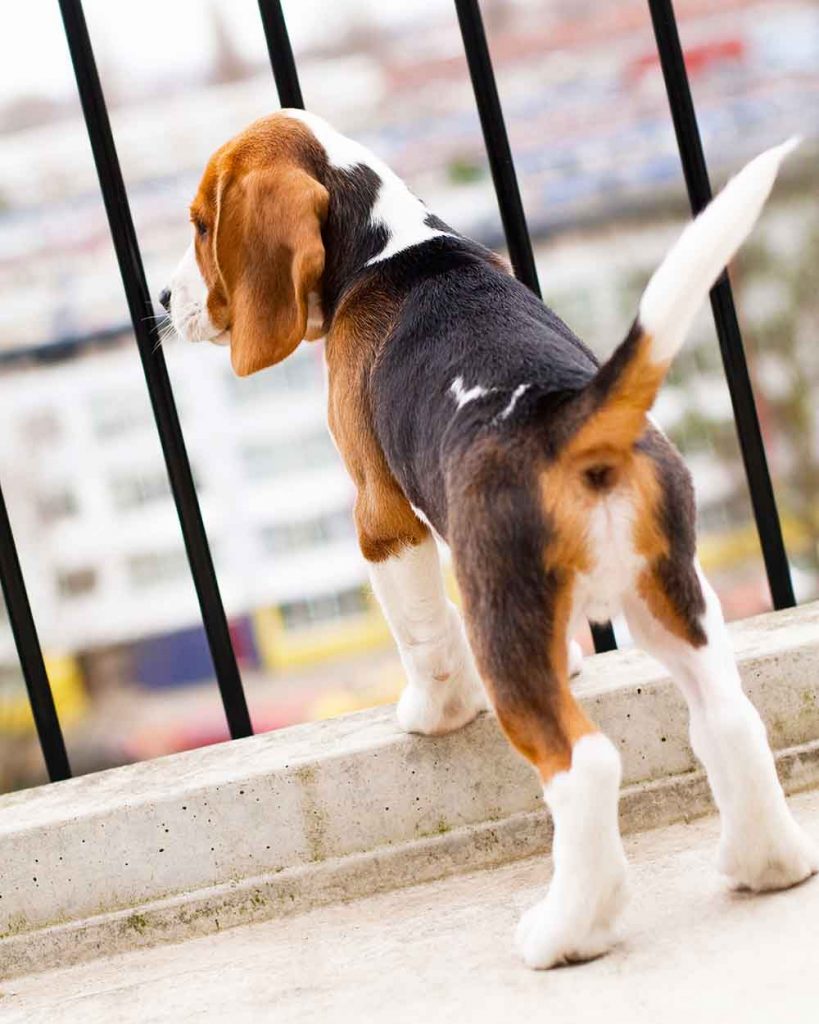
A puppy can wriggle through small gaps making balconies with railings a particular hazard.
Your puppy can slip under and through the bars, and because it lacks experience, it can wriggle through and fall without appreciating that there is a drop.
An agile adult dog from one of the bigger, stronger breeds can jump between six and eight feet without an issue.
Your puppy is not in that league (yet), but one or two feet is a possibility and more for larger puppies.
The international residential code specifies balcony railings must be at least 3 feet. However, local state rules may amend this requirement.
In practice, apartments and condominiums build balcony railings at 4 feet high, and potentially more for towers tens of stories tall.
Can your puppy jump over a three-foot wall?
It depends on its age and breed, but some can easily jump this height if motivated by fear or excitement.
In the early days of puppy ownership, the greater risk is that your puppy wriggles through the railings rather than jumping over them, but as it matures, the wriggle through risk reduces, and the jump risk increases.
How Far Can a Puppy Fall Without Injury?
Puppies (like human babies) have softer bones than adult dogs and are surprisingly resilient to small falls and drops.
The distance from your arms to the ground is usually not an issue, but even this small drop can result in broken limbs, damaged necks, concussion, or bruises and strains.
If your puppy jumps or falls off your balcony, take it to the vet for a professional examination. Explain that the puppy has dropped from a height and let them assess the extent of any damage.
Sadly, vets see many dogs and puppies that fall or jump from balconies and other high places over a year.
What Are the Risks for Your Puppy on the Balcony?
The principal risks of letting the puppy onto a balcony include:
Falling from Height
Puppies don’t have the experience of adult dogs – they are learning the ropes.
A puppy is small and agile and can slip through the railings and suffer a traumatic fall. Plus, if you have furniture on the balcony, this can give the puppy access to get over the bars.
The puppy is intent on exploring and doesn’t understand the risk of harm.
Trapped in Railings or Balcony Slats
The puppy may be too large to get through the railings, but that doesn’t mean it can’t get its head stuck or a paw trapped in the balcony floor.
In the struggles to free itself, your puppy can receive injuries, plus you may need professional help to release your puppy from its predicament.
This assistance may involve cutting into the railings or the floor, turning into an expensive repair.
Toxic Plants
Many homeowners like to have some growing plants on their balconies for attractive decoration and improving the air quality.
A young puppy explores the world through biting and chewing – especially when replacing its baby teeth with sharp and painful adult teeth.
Some plants are toxic to dogs – at best making your puppy more inclined to vomit and at worse poisoning with fatal consequences.
Wildlife
On the balcony, your puppy may encounter insects like bees or wasps. A sting is painful and traumatic and will frighten your puppy.
Plus, your puppy may have an adverse reaction to the sting.
Depending on where you live, the beasties your puppy may encounter on the balcony can be more dangerous.
Some birds and other animals can attack puppies – seagulls are very aggressive in the breeding season.
Weather
Out on the balcony, your puppy may be in full sun and at risk of dehydration and heatstroke. Alternatively, the temperature may be too cold, and your puppy can get hypothermia if left outside for too long.
The weather risks to your puppy depend on your climate and balcony position.
Puppies are young animals and need greater protection from the elements.
Other Risks
Other risks to your puppy on the balcony depend on what you keep on your balcony.
Barbecue grills and patio heaters are a potential burn risk, but even furniture and bikes can fall and damage your pup while it is exploring.
How Can You Puppy-Proof Your Balcony?
You can minimize the risk to your puppy by assessing potential hazards and acting to prevent or reduce them.
1. Consider the Puppy Breed
When working out how to puppy-proof your balcony, consider your puppy breed.
A chihuahua puppy’s capabilities are different from a Great Dane, and you need to consider the risks from the puppy’s perspective.
Small dog breeds have tiny puppies that can wriggle through the smallest gap and are likely to get badly hurt when falling from height.
On the other hand, they can’t reach or jump as far as larger dog breeds, and a lower wall will keep them in place.
Plus, if you decide to put the puppy in a large dog cage on your balcony, they have plenty of room to run about, and you can be confident they will stay in place and be safe and happy.
An adult dog that weighs 30 pounds or under classes as small.
Any adult dog weighing over 55 pounds classes as large. The puppies are larger and more energetic.
Although they can’t get through tiny gaps (but the holes they can get through will surprise you), they can jump higher and use furniture to gain access to places that should be out of reach.
A medium-sized dog fits the range between small and large. A medium-sized puppy may tend to the small or large end of the range depending on the breed.
These puppies can get through smaller gaps than a large dog but not jump quite as high.
Whatever puppy breed you have, observe its capabilities by playing with it in an indoor setting.
Can your puppy jump onto the sofa or climb the stairs?
If it is chasing a ball, can it jump over a low obstacle or a higher one?
Puppies in the same breed can vary in physical capabilities, and your puppy will rapidly grow and develop. Understanding what your puppy can do is the first step in working out how to puppy-proof your balcony.
2. Screen Your Balcony
You can puppy-proof your railings by adding mesh or screening to prevent your puppy from wriggling through the gaps. You must fix it securely and regularly check it for damage.
Puppies are very effective at finding and making weak spots in fencing.
The puppy proofing can be a permanent or temporary fixture, depending on your preference for how you decorate your balcony.
Assess the possibility of your puppy climbing on furniture to get over the balcony wall and remove any potential climbing points.
If you think it is a possibility that the puppy can jump the balcony wall, then increase the height by adding a secure trellis or another barrier above the walls.
Lay an old carpet, rubber matting, or artificial turf over your balcony slats while your puppy is still growing to prevent its paw from becoming trapped between the slats if you think that is a potential risk.
3. Identify Plants Toxic to Your Puppy on Your Balcony
Check out the contents of your pots, tubs, and planters with the toxic plant list from the ASPCA (link below).
Remember that non-toxic plants may upset your puppy’s tummy if ingested.
In a fit of enthusiasm, your puppy may dig out your plant pots and try and eat the soil and roots as well as the leafy greens.
Some puppies have a compulsion to chew and eat anything they come across, and if this is an issue, you may want to elevate your plants out of the puppy’s reach.
But make sure you don’t create a new hazard of a crush injury from falling plant pots.
4. Assess the Weather Impact on Your Puppy Playing on the Balcony
Assess the weather risks for your puppy while out on the balcony.
Provide shade and water to assist in hot sunny weather and a warm retreat for windy and cold weather. Limit your balcony playtime to an amount of exposure that won’t cause problems.
Keep checking that your puppy remains happy and does not have issues with the heat or cold.
An adult dog will move out of the baking sun and into the shade to cool down. Unfortunately, your puppy hasn’t got that level of experience yet, so you need to decide when it is time to cool down.
5. Identify the Other Risks to Your Puppy
Look at your balcony through puppy eyes.
Can you knock into that bike?
Can your puppy touch a hot patio heater?
You can move potential risks or create a safe play area with safety gates or a puppy playpen.
The best way of ensuring your pup doesn’t come to harm on the balcony is never to let the puppy go onto the balcony without supervision.
FAQ About Balcony Safety for Puppies
Here are the answers to typical questions new puppy owners have about puppies and balconies:
Can I Leave My Puppy on the Balcony While I Go to Work?
The short answer is no. You can’t control the weather or the outside environment.
Some working dogs live outside, but they do so in ideal conditions for that dog.
Your puppy is likely to suffer on your balcony – it risks physical harm, theft, heatstroke, hypothermia, and dehydration.
Think of other options if you think your puppy is better on the balcony because it can’t mess in the house or destroy your stuff.
Caging your dog while out of the house is not cruel; it often makes the dog feel more secure. Naturally, you equip the cage with water and dry food to leave the puppy comfortable and safe.
Can My Puppy Sleep on the Balcony Overnight?
This question is more challenging to address – it depends on your puppy’s breed and your climate.
Allowing your puppy to sleep overnight in a cage on your balcony in mild weather may be ok, but you can’t monitor how safe it is overnight.
A wild dog has the benefit of packmates to keep it warm in freezing weather, and it can move to a cooler spot in hot conditions. Your puppy on your balcony doesn’t have that option.
The straightforward answer is that if you would be happy to leave a human baby on the balcony overnight, then your puppy may be alright.
But if in doubt, don’t – let your puppy sleep somewhere safe and secure where you can hear if it gets in distress.
If I Have Visitors, Can I Shut My Puppy Out on the Balcony?
If you are confident that your balcony is puppy proof, the weather is mild, and you can see your puppy from where you are talking to your visitors, then a short period of puppy playtime on your balcony may work well.
Not everyone likes dogs, and the weather may not be suitable for your puppy next time you have guests, so a better strategy is to have a designated space for your puppy (and your soon-to-be adult dog) in your home.
Using a child’s safety gate with a door can create a designated room where your dog can see your guests but not interact with them.
When your puppy is small, a playpen is another safe option for socializing your puppy with visitors without upsetting your guests.
If you wish, you can train your puppy to retire to its safe spot when visitors arrive. You can then specifically invite your dog to meet your visitors if they enjoy canine companionship.
As your puppy matures, it will see the home as its territory and may view visitors as a potential threat.
Shutting your puppy onto the balcony when a visitor arrives may reinforce that impression. Plus, the puppy may regard the balcony as a punishment space and cease to enjoy spending time there.
Balcony Safety for Puppies
You can enjoy playtime with your puppy in the fresh air on your balcony if you take a few simple precautions.
Remember your puppy can’t assess risks or heights, and it is your responsibility to look out for your puppy’s safety.
The balcony is not the place to leave your puppy while you go shopping or out to work.
While your puppy is growing and developing, you need to supervise its outdoor playtime to protect it from physical injury and climate conditions.
Both you and your puppy will have more fun together if you spend some time puppy-proofing your balcony. In a few months, your puppy will grow into a more mature and sensible dog, but for now, play safe.
References:
https://www.aspca.org/pet-care/animal-poison-control/dogs-plant-list