

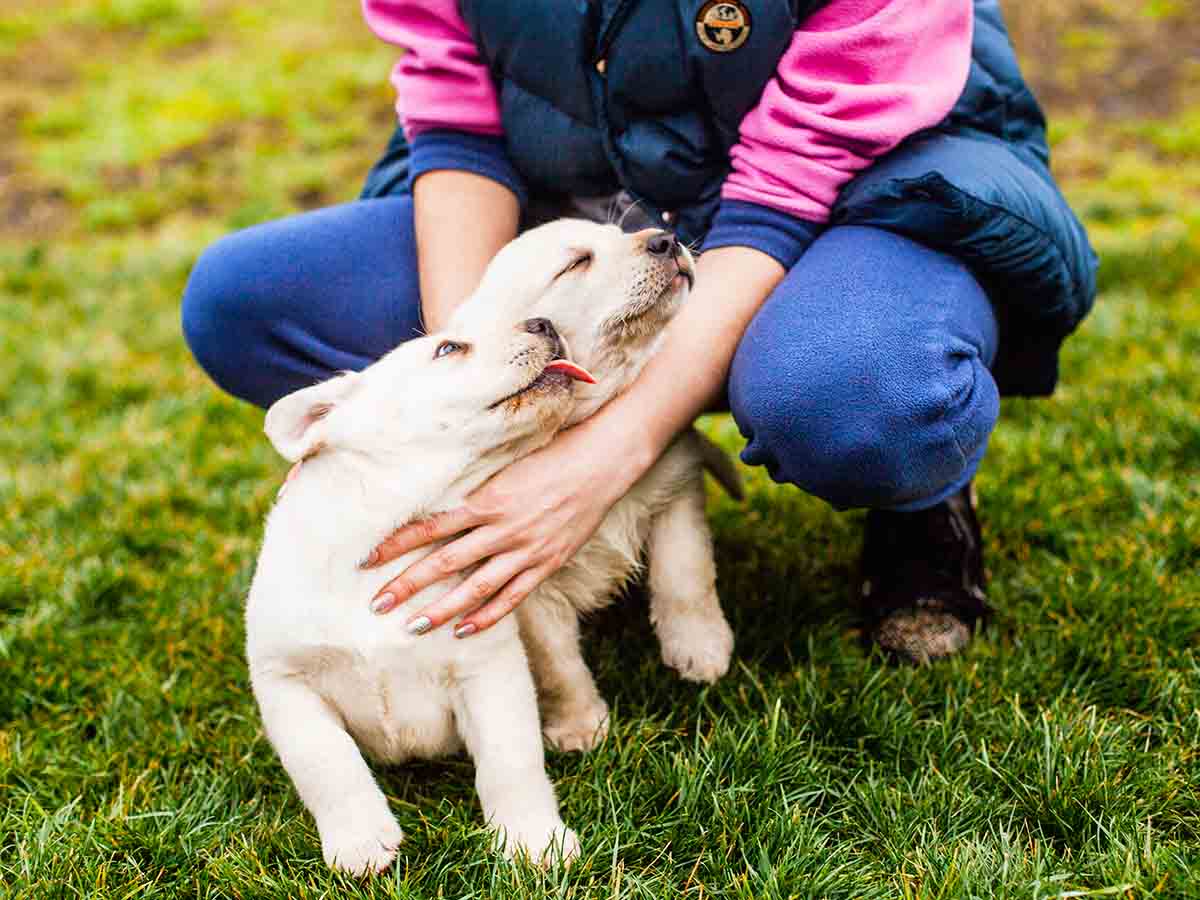
Are You a Puppy Parent? 7 Facts Reveal How Puppy Sees You
Many people refer to their canine companions as fur babies and lavish the degree of love and attention on their puppy that other people expend on their human child.
But does your puppy see you as a parent, friend, or master?
1. What is a Parent?
You can put together a long list of what a parent does, but ultimately a parent is a caregiver.
A human child forms a bond with its primary caregiver, not necessarily the biological parent. If the birth parent is lacking or missing, a human child creates the equivalent of a parental bond with the most appropriate caregiver.
2. What Does a Primary Caregiver Do?
The primary caregiver in a child’s life provides:
- Basic needs.
- Emotional support.
The basic needs cover food together with a safe and comfortable place to sleep and play.
Emotional needs include physical affection demonstrated by hugs and cuddles, a person to run to for support when frightened, and a teacher of life experiences like washing and behaving.
Does any of this sound familiar to your role in your puppy’s life?
3. Does Your Puppy Respond to You as a Caregiver?
The science says yes, your puppy responds to you as its primary caregiver in the same way as a human child.
Your puppy builds a bond with you that enables it to feel confident in your presence.
Your puppy demonstrates this bond by:
- Affectionate contact – cuddles, full-body tail wagging, rushing to greet you, and attempting to lick your face or any part of you it can reach.
- Paying attention to your instructions and co-operating with training activities.
- Running back to you if scared or uncertain.
The scientific studies show that you, as a responsible puppy parent, are a secure base and a source of comfort.
So much so, that if left in a strange place with an item of your clothing, your puppy chooses to snuggle up to it in preference to any other thing.
4. Does Your Puppy Love or Worship You?
Many people talk about preferring dogs to humans because a dog loves you unconditionally. Others state the puppy and ultimately the dog regards its human as a divine being who can do no wrong.
But which approach is correct?
Can your puppy feel love?
Research indicates animals, not just dogs, experience emotions in much the same way humans do – positive and negative.
Your puppy can experience and give love; if you are loving towards your puppy, then the bond that forms is a loving one on both sides.
Dogs famously remain loyal after the death of a beloved owner. There are many stories like Greyfriars Bobby, who spent fourteen years grieving the loss of his human companion.
Although typically it is the human left grieving the loss of a beloved pet, your puppy has access to the same range of emotions as you.
Do your puppy’s feelings move to the level of worship?
If worship is intense love, then if you form a strong bond with your puppy and it attaches to you, it will want to be with you all the time and mourn even a temporary absence as if its little puppy heart is breaking.
5. Does Your Puppy Understand What You Say?
This is a complicated one – is it the words, tone, body, language, or everything together?
A human baby learns language through repetition and experience, and a human is born with the capacity to learn language.
Most human communication is nonverbal, and your puppy and a human baby have much in common in the early stages of language development.
The difference lies in the fact that your puppy’s ability to think and solve problems will max out at the equivalent human capacity at six to twelve months.
Some breeds are more intelligent than others. You teach your puppy language, and an intelligent dog has a vocabulary of meanings for around 100 to 200 words.
At the same time, you teach your puppy commands and the associated words your puppy teaches you, its language.
You will quickly pick up on excited yips to I’m unhappy whines. Your puppy will tell you when it needs to potty and wants to play.
Like a parent with a child, you and your puppy learn to communicate.
You can talk to your puppy; puppies are excellent listeners.
Your puppy probably doesn’t understand that you are unhappy with your boss or why, but your puppy will keep your secrets and be happy to comfort you in your distress.
6. Does Your Puppy See Everyone in the Family as a Parent?
Dogs and humans share a social sense of who is a leader, follower, and higher in social rank. Most social animals have an order and structure in their family and tribe.
Your puppy spends its formative months working out where it is in the social ranking and when it enters the teenage years, it may rebel and try to assert dominance over other family members.
Your puppy soon identifies “its” person, typically the one that gives it food, takes it for a walk, and prioritizes its needs. The rest are part of the pack, but not the one.
That doesn’t mean your puppy doesn’t enjoy and feel affection for other family members, but it is not a parental bond for everyone.
7. Does Your Puppy Think It is Human?
As far as anyone knows, no puppy philosophers are pondering the nature of their existence.
A puppy seeks to have its needs met and to follow the social norms in your house. Your puppy learns what you teach it, but its base nature is that of a dog.
It won’t bother your puppy that the human children go to school, and it doesn’t, because your puppy is a straightforward creature that likes to eat, play and enjoy a comfortable nap.
The problem arises when you start thinking of your puppy as a human with a human capability and treating it like a human in a fur body.
Your puppy is not human and never will be. If you give it a command and have trained it well, it will behave within the boundaries set.
Your puppy can chew your slipper today, and you can lecture it on the wrongness of slipper chewing. Tomorrow, given the opportunity and lack of alternatives, it will chew the other slipper.
Your puppy is not bad or willfully disobeying you; your puppy is behaving naturally for a dog.
Your puppy doesn’t think it’s human, but crucially you shouldn’t expect your puppy to behave like one.
Are You a Puppy Parent?
When you bring a puppy into your life, you take it away from its biological mother at a painfully young age.
Your puppy needs a substitute parent or responsible caregiver, and you choose to take on that role. Your puppy doesn’t have a say in its fate.
If you behave like a good puppy parent, your puppy will form a loving bond with you.
In the end, it does not matter if you or the puppy think of each other as a parent or child; the love remains.
References:
https://www.medicalnewstoday.com/articles/262477#1
https://academic.oup.com/bioscience/article/50/10/861/233998