

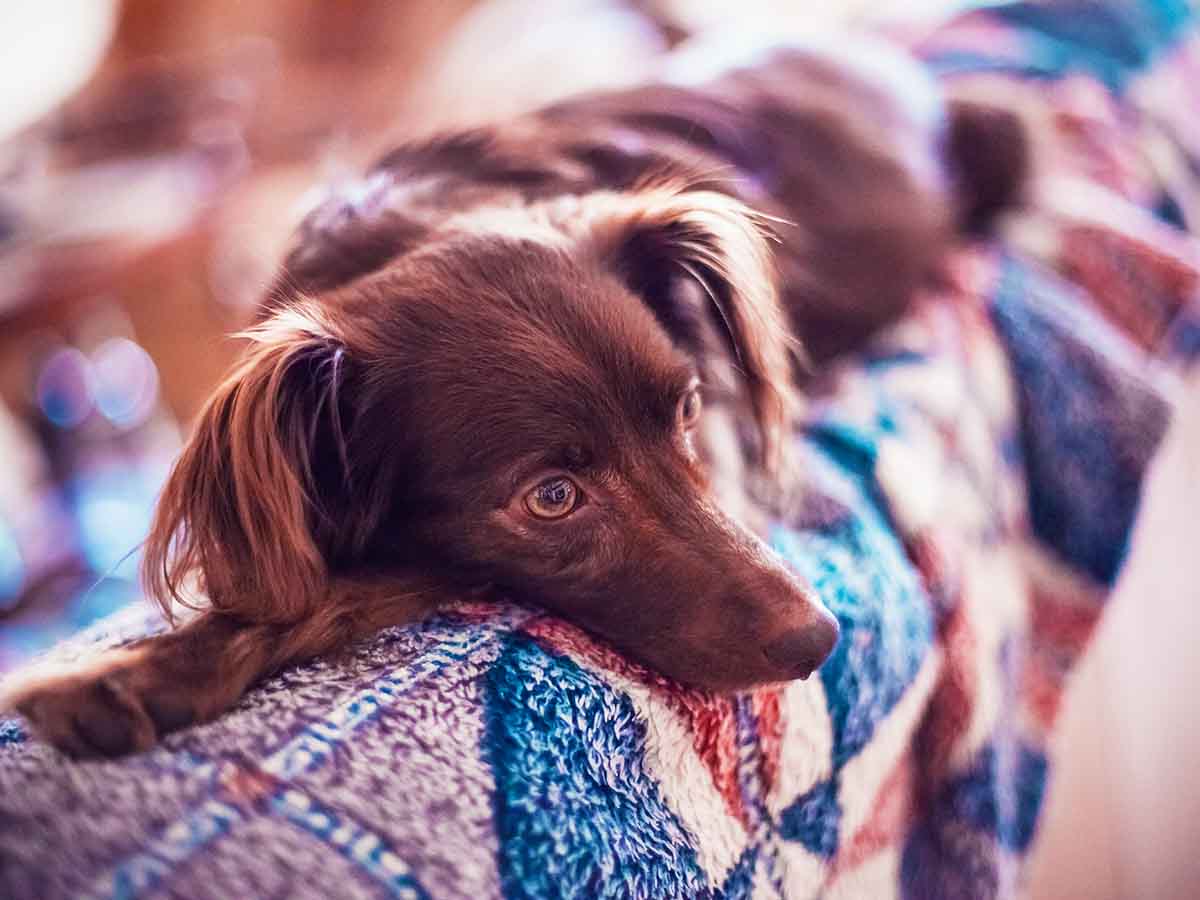
Jealous Puppy? 5 Situations to Be Sensitive to (& Manage)
Jealously is a complex mixture of emotions revolving around a threat to a relationship or possession.
You may be familiar with sibling rivalry where one child always wants what the other child has; the root of jealousy is insecurity and fear of loss.
Can your puppy feel jealous?
Psychological studies with dogs show that puppies can exhibit what looks like jealousy in humans.
Whether the puppy feels jealousy or simply acts on instinct to protect its territory and access to food and shelter is another complex question.
Signs of Jealous Behavior
Your puppy will show jealous or possessive behavior by:
- Whining and pushing into any cuddles with other people.
- Growling at people who try to sit next to you when your puppy occupies your lap.
- Body blocking another dog or pet from gaining access to you.
All the jealous behavior involves pushing away others and protecting access to the object of the puppy’s possessive behavior.
Why Do Puppies Feel Jealous?
The root cause of your puppy’s jealous behavior is insecurity and fear.
Typically, a puppy will exhibit jealous behavior if unsettled by changes like moving to a new home, the arrival of a new pet, baby, or visitor.
1. Do Puppies Get Jealous of Other Puppies? Why?
You may think that adopting a pair of littermates means both puppies can have an affectionate playmate for the rest of their lives.
In practice, you may find that one puppy is excessively possessive and jealous, forever pushing the other puppy away from you and other people.
There are a couple of factors at play in your puppy dynamics that may complicate recognizing jealousy:
- Dominance – if you have two puppies, they can’t both be top dog, and a lot of the behavior you see may be down to one puppy fighting to establish dominance.
- Competition – instinct drives the puppy to establish access to food and shelter, even if this is at the expense of the other puppy.
- Insecurity – one puppy may need a lot of comfort and affection because it feels anxious and is constantly trying to get as much of your attention as possible.
- Attachment – some breeds firmly bond with a single human and rigorously guard that human.
Whatever the root cause of the behavior, a jealous puppy will do its best to come between the other puppy and you, effectively trying to drive it to the fringes of the pack.
2. Do Puppies Get Jealous of Adult Dogs? Why?
Many people bring a puppy into a home where an adult dog is in residence.
Perhaps you like to keep your dog in pairs for the company of each other, and the puppy is a replacement companion.
Alternatively, the adult dog may be elderly, and you hope the company of a lively young puppy may give your adult dog a new interest in life.
Whatever your reason for introducing a puppy into the mix, the following scenarios may occur:
- Your adult dog becomes jealous of the new puppy for monopolizing your time.
- The puppy becomes jealous of the adult dog because it feels insecure about its new home.
- Dominance – your puppy may feel it deserves the top dog space in your little pack of humans and dogs.
3. Do Puppies Get Jealous of Babies? Why?
As far as the puppy is concerned, a new (or existing) baby in the house is competition for time and attention from the primary caregiver.
The puppy does not distinguish between the baby as a young human and itself as a young dog. The complexities of human relationships are not part of your puppy’s understanding.
Before the arrival of the new baby, the puppy probably has more cuddle and playtime.
The baby’s appearance leads to the puppy getting less attention and affection – it is not a surprise when the puppy resents its loss of status and exhibits jealous behavior seeking attention.
Plus, the arrival of a baby produces a host of new objects that are potential puppy toys.
Your puppy doesn’t see the baby’s toys any differently from its own toys.
Your puppy doesn’t understand why you become irritated when it liberates a teddy bear from your baby’s grasp and runs off with the prized toy.
Some of the behavior you think of as jealousy may be simple confusion in your puppy’s mind about how to act around the baby.
4. Why Do Puppies Get Between Couples?
Stories abound of jealous puppies that drive a wedge between couples because the puppy won’t tolerate the partner next to “their” human.
A jealous puppy doesn’t sleep between you on the bed for extra warmth but ensures that it is body blocking the partner from approaching too closely.
A puppy that attaches to a single human is jealous of anyone’s partner, friend, or other family members who attempt contact with their human.
5. Jealousy vs. Possessiveness
Your puppy may exhibit possessive behavior over access to its toys, bed, or food bowl.
The possessive behavior stems from the same roots as jealous behavior, but your puppy is labeled as jealous when its possessive behavior involves a human.
This instinct to “guard” its human is ideal for a working dog in security roles but not so helpful in a family pet.
Possessive or jealous behavior that interferes with normal human relationships is always problematic for both the puppy and the owner.
Are Some Dog Breeds More Jealous?
Although any puppy craves your attention, some dog breeds are prone to taking this possessive behavior to extreme jealousy.
These puppies may either firmly attach to a single owner or suffer excessive levels of separation anxiety.
- French Bulldog – ideal companion animal but suffers from boredom and separation anxiety.
- Australian Shepherd – protective herding instincts mean they want to defend you from everyone.
- Labrador Retriever – the same qualities that make them excellent assistance dogs make them prone to jealousy.
- American Pit Bull Terrier – particularly jealous of other puppies, and this may spill over to aggression.
- Cocker Spaniel – loving and cuddly, a cocker spaniel puppy wants all of your attention all of the time.
- German Short-haired Pointer – a working dog that forms a strong attachment to its owner.
- Golden Retriever – the jealous behavior can spread to resenting you working at a computer or doing anything other than spending time with the puppy.
- Border Collie – another herding dog with super-strong herding instinct.
- Brussels Griffon – a lap dog that will defend its space to its last breath.
- Boston Terrier – separation anxiety and a burning need for attention.
Although jealous behavior may strike you as cute and the evidence of your puppy’s love for you, it is undesirable and unhealthy for both you and your puppy if allowed to develop into a permanent aggressive fixation.
How to Prevent Your Puppy from Developing Jealousy
A calm, confident puppy with plenty occupying its time and energy is less likely to develop jealous behavior with an individual focus.
Part of your puppy’s jealous behavior is stepping up to the role of leader in your mixed pack of humans and animals.
Regular training in obeying simple commands like “sit,” “leave,” and “bed” reinforce the rules of obedience and give you a tool to restore calm behavior if your puppy starts barking or growling at other people.
Refusing to “reward” undesirable behavior with your attention can help stop a negative behavior spiral from forming – from your puppy’s viewpoint, any attention may be worth it.
Plus, if you can, share out the tasks of puppy interaction among family members to avoid a fixed attachment from forming.
How to Deal with a Jealous Puppy?
The best method for dealing with a jealous puppy and changing its behavior depends on the type of jealousy.
Puppy vs. Other Dog
If your puppy is jealous of another puppy or dog, you may feel it is best to separate them, but this action reinforces the behavior.
It is time to treat the two dogs as a unit – by all means, keep them separate when not supervised to avoid injury.
Give both puppies a treat only when they sit calmly next to each other and walk, play, and feed both animals together.
Rewarding calm behavior from both should establish harmony, but you may want to ask a puppy behavior therapist for assistance in initial socializing and training.
Puppy vs. Baby
Adjusting to a new baby is a big step for the entire household.
The first stage is getting your puppy to be calm when scenting the baby.
You can use an item of baby clothing (before it goes in the wash) to introduce the scent to your puppy and reward the puppy for associating positive feelings with the scent.
You can also treat the puppy before and after you feed the baby (use low-calorie treats) to build positive reinforcement that the baby is not a threat to the puppy.
It is essential to ensure that your puppy and baby are not left unsupervised together because even if your puppy only intends to play, a puppy has strong teeth and jaws and a different approach to a human.
It may seem efficient to combine taking your baby and puppy out for a walk but make time for your puppy to have exclusive walks and playtime with you.
Treat walking your puppy alongside the buggy as an extra treat rather than the main event.
Possessive Behavior
The issue with allowing possessive behavior from your puppy is that it can escalate into aggression which is more complicated and challenging to counter.
If your puppy tries to drive another person away from you, remove it from your lap or make it sit at your feet, or give it a time out in a puppy playpen until it relaxes.
The best way to deal with possessive behavior is to replace it with a better habit – if your puppy tries to push your partner away, put your partner in charge of puppy feeding and treats.
Distraction before your puppy exhibits possessive behavior is another effective tool to dissipate jealous feelings before they take hold.
Your Puppy, Jealousy, and You
If your puppy’s jealous behavior is your first experience of puppy jealousy, don’t be afraid to get help from a professional.
Puppy socializing and training gives you the foundation stone for years of happy canine companionship. It is far better to set positive groundwork now than deal with problem behaviors later.
You can bond with your puppy and have a harmonious household for your puppy, other animals, and family members.
You don’t need to put up with puppy jealousy.