

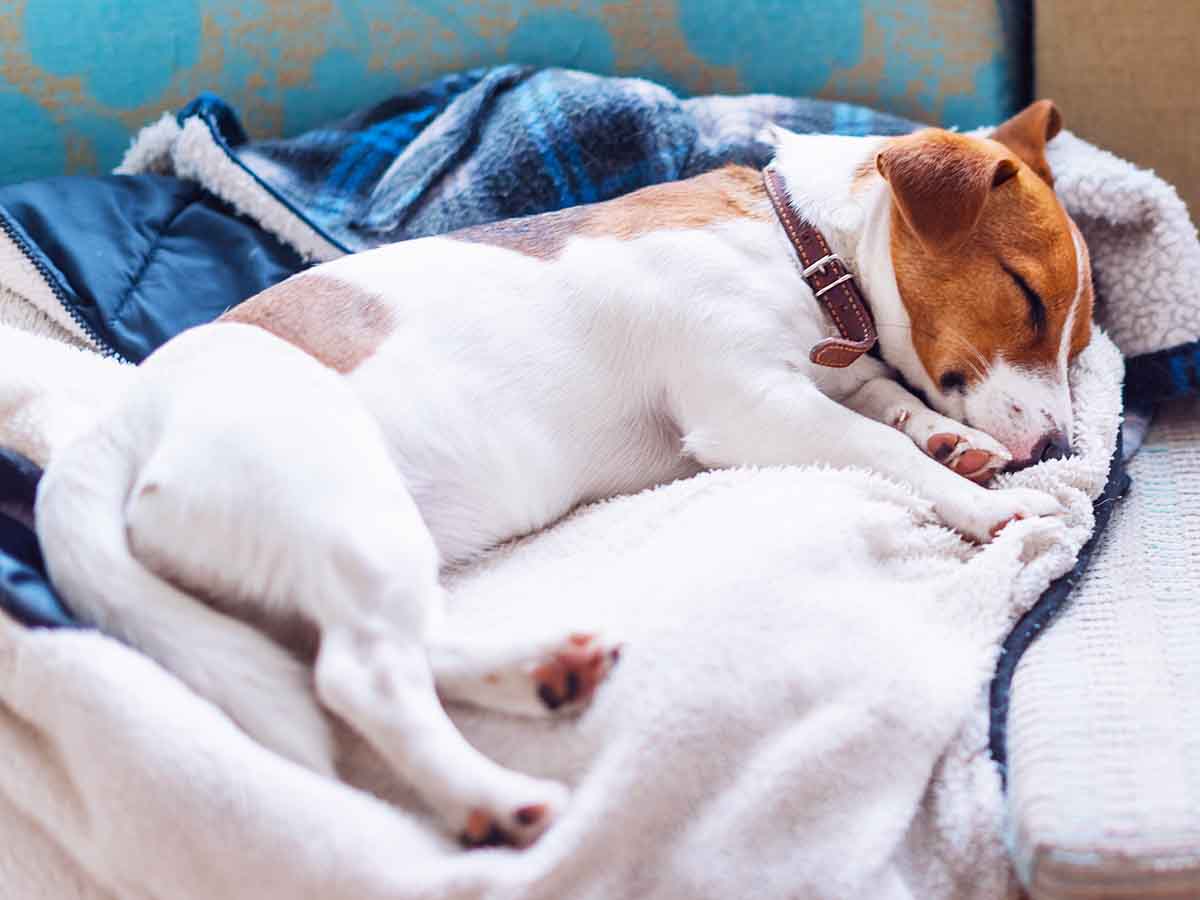
Puppy’s Sleeping Habits: 42 Positions & Quirks (Revealed!)
Puppies need a lot of sleep, but where they choose to sleep and how they sprawl, curl, or flop may surprise you.
Is your puppy doing what comes naturally, or is there something odd about your puppy’s sleeping habits?
1. Why Does My Puppy Sleep on Its Back?
Sleeping on its back with its paws in the air, your puppy looks super cute, but is that natural?
Surely sleeping on your back leaves your vulnerable belly exposed for more than a surprise tummy rub?
The other name for this sleeping position is “belly up,” and it shows your puppy isn’t scared or fearful. Your puppy is confident that it can sleep on its back and cool down if it needs to on a hot summer night.
Your puppy can only sweat through its paws and if it is superhot, exposing its belly to the cool breeze is an easy way to cool down.
If your puppy takes to sleeping on its back, the room may be too warm, and you might want to dial down the heating or turn up the air conditioning.
But, like people, some puppies love to sprawl on their backs when sleeping.
2. Why Does My Puppy Sleep with Its Eyes Open?
Although your puppy may look as if it is asleep with its eyes open, it could have its third eyelid closed.
Unlike you, your puppy has a third eyelid which means it can sleep with its eyes open while dreaming.
If your puppy has suddenly started sleeping with its eyes open, then there could be a medical issue:
- Seizures – some breeds are prone to seizures, and these can happen while apparently asleep. Your puppy will look different from when it is dreaming. A puppy having a seizure is tense, jaws may snap, and your puppy may make distressed sounds. Talk to your puppy in a calm voice and ensure it is in a secure area. After it recovers, please take it to your vet to look for the underlying issue.
- Cherry eye – puppies with flat faces like a bulldog or pug are prone to an infection that causes the third eyelid to swell. It is a genetic condition and won’t clear up on its own; your puppy will need a simple surgical procedure.
- Lagophthalmos – a big word meaning your puppy can’t close its eye properly. It may be genetic or an underlying disease like glaucoma. It might be worth asking your vet if your puppy is from a flat-nosed breed and always sleeps with its eyes open rather than the occasionally spooky nap while dreaming.
Your puppy occasionally sleeping with its eyes open is nothing to worry about and is probably an exciting dream or a temporary rousing into a lighter sleep.
Around 20% of humans also sleep with their eyes open for some of the night, and so do some other animals.
3. Why Do Puppies Sleep with Their Tongue Out?
The internet names this habit (not restricted to dogs) as “blepping” when the tongue protrudes for no apparent reason like panting or dehydration.
Flat-faced dogs (pugs, Boston terriers, bulldogs, and boxers) have shorter airways and frequent issues with breathing.
These puppies stick their tongues out to cool down or breathe more easily.
Boxers are a breed that occasionally has a tongue that is too large for their mouths, and your puppy has no choice but to leave part of its tongue hanging out when asleep or sitting around.
For most puppies, the tongue may slip out for a short while during a nap and then go back into its mouth.
Perhaps it is dreaming of drinking water, subconsciously thirsty, or simply needs to cool down.
4. Why Does My Puppy Sleep with Its Mouth Open?
Your puppy has limited options for cooling down when too hot, and one reason for your puppy sleeping with its mouth open may be that it is trying to cool down.
A young puppy may still dream of suckling, and the open mouth is, in this case, your puppy putting its mouth in the suckling position.
As your puppy grows, this memory will fade.
The flat-nosed breeds with breathing issues often have puppies who need to sleep with their mouths open, but most puppies occasionally open their mouths while sleeping.
5. Why Does My Puppy Twitch or Jerk in Its Sleep?
Your puppy can dream, and while dreaming, its legs may twitch and its body jerk.
It may produce some cute vocalization.
No one is quite sure what puppies dream about, but your puppy has regular REM cycles (Rapid Eye Movement), and this type of sleep is essential for a healthy, happy pup.
6. Why Does My Puppy Jump in Its Sleep?
When your puppy jumps in its sleep, it is a more active form of twitching associated with a dreaming puppy.
If you worry that the jumping is, in fact, a seizure, observe your sleeping puppy.
Seizures are different from dreaming because your puppy will have rigid, stiff, and violent movements and potential involuntary urination or defecation while asleep.
Dreaming puppies don’t soil themselves.
If your puppy seems disoriented when it wakes with excess drooling and panting, it is worth talking to your vet about the possibility of seizures.
Most often, when your puppy jumps in its sleep but is otherwise relaxed, it is only dreaming.
7. Why Does My Puppy Pant in Its Sleep?
There are plenty of reasons why your puppy may pant while sleeping:
- Too hot – it needs to cool down.
- Dreaming – short duration and nothing to worry about.
- Growing pains – again, rapid panting for a few seconds, and then it stops.
- Anxiety – a scared puppy may pant in its sleep because of fear; ensure your puppy has a safe, comfortable palace to sleep in, and this panting should cease.
- Injury or illness – prolonged panting while asleep may point to an underlying health issue to discuss with your vet.
- Worms – puppies can be born with worms and need regular worming. If your puppy pants in its sleep and is coughing, it may need worming treatment. If you haven’t recently wormed your puppy, talk to your vet.
- Respiratory problems – some breeds are more prone to these, but all puppies can catch respiratory diseases. If the panting goes on for several minutes at a time, you may want to rule out this cause, especially if your puppy pants frequently during the day.
8. Why Does My Puppy Cry in Its Sleep?
As well as twitching, jerking, and running, your puppy will whine, cry and maybe bark while dreaming.
Most young animals will frequently cry or make distressing sounds in their sleep, and it is nothing to worry about.
Your puppy may be having a bad dream, but don’t be tempted to wake it.
Dreaming is how your puppy organizes its memories and copes with busy and exciting new experiences.
9. Why Does My Puppy Sleep All the Time?
Your puppy grows rapidly in the first few months of its life, and most of its growing takes place while it is asleep.
Your puppy has short bursts of activity followed by a refreshing nap.
As an adult dog, it is still going to sleep a lot, but as a puppy, it routinely sleeps to rest its bones and muscles and digest its frequent meals.
10. Why Does My Puppy Sleep in the Day and Wake at Night?
It seems strange that your puppy needs to nap throughout the day and then wakes up at night. But this behavior is no different than a human infant.
There are plenty of reasons for your puppy to wake at night, ranging from needing a bathroom break to feeling lonely.
Your puppy sleeps in the day and wakes at night because it is young.
As your puppy matures, it will need less sleep and it will be able to sleep through the night without needing a bathroom break.
But part of your puppy’s role in your household is to alert you to potential threats, and your puppy will continue to wake in the night if it hears strange noises.
11. Why Do Puppies Sleep After Eating?
Digesting your food takes a lot of energy, and wouldn’t you like a nap after a heavy meal?
Encouraging your puppy to have a post-meal rest is a healthy option if you have one of the more giant breeds with a tendency towards bloat.
Regardless of breed type, too much activity immediately after a meal may upset your puppy’s stomach. The food will benefit your puppy only if it stays in the stomach to digest.
A quiet nap after a meal is useful and normal for your puppy.
12. Why Does My Puppy Sleep So Little?
Everyone tells you that puppies sleep a lot, yet your puppy is a bundle of energy and hardly seems to sleep at all.
Is something wrong?
Why does your puppy sleep so little?
Your puppy, like a human toddler, needs daytime sleep.
If you live in a busy household and your children want to play and cuddle the new puppy all the time, there is a risk that the puppy may stay awake and become overtired and grumpy.
Plus, if people are happy to hold the puppy while it sleeps, it may prefer company when it sleeps.
Puppies do better with a routine that includes daytime naps to digest food and recover from play sessions.
If your puppy seems reluctant to sleep, schedule some quiet time in a puppy crate or playpen with reduced stimulation to give it the option of fitting in a nap.
13. Why Does My Puppy Sleep So Lightly?
There are four stages of puppy sleep:
- Stage one – dropping off, light sleep.
- Stage two – slightly deeper but still only napping and will wake quickly.
- Stage three – deeper still and doesn’t respond to noises.
- Stage four – REM sleep.
Your puppy’s deep sleep zone lasts a quarter of the time of your deep sleep, so most of the time, your puppy is sleeping lightly and wakes in response to noise and activity.
Your puppy cycles through the four stages frequently, but most time is in stage two sleep, so it seems as if your puppy is a light sleeper because your puppy wakes easily.
This balance of light vs. deep sleep is why dogs make excellent guards. It is natural for your puppy to sleep lightly.
14. Why Do Puppies Sleep More on Some Days?
It is natural for your puppy to have the odd off day when it wants to catch up on its rest.
If you’ve had a busy day out exploring new places, your puppy may be extra tired the following day.
If you’ve ruled out illness and the excess tiredness compared to normal puppy behavior is limited to one day, then the most likely cause is that your puppy is catching up on sleep and having a bit of a growth spurt.
15. Why Does My Puppy Sleep Standing or Sitting Up?
Human babies may fall asleep while sitting up, but they lose control of their muscles and fall over. The internet contains many pictures of babies falling asleep and face planting into their dinner.
Your puppy can fall asleep while standing or sitting but doesn’t lose control of its muscles and remains asleep in that position.
The nap is short, and then the puppy wakes up.
Many other animals can remain standing while sleeping as an adaptation to needing to be alert for danger.
If your puppy is sleeping while sitting or standing, it may show that it is overtired and needs more structured nap time. This type of sleeping behavior is more common in working breeds like collies and shepherd dogs adapted to safeguard a herd of sheep or cows.
Occasionally falling asleep while sitting or standing isn’t a huge problem, but ideally, your puppy lies down for a higher quality nap.
16. Why Does My Puppy Sleep Stiff?
Many puppies sleep on their sides with their legs stiff as if walking along and falling over.
The legs are so rigid that they remain suspended in the air in some cases.
This sleeping position typically indicates your puppy is in a deep sleep (for now anyway) and is happy and relaxed about its environment.
When your puppy moves into REM sleep, the legs are in the perfect position for dream running and twitching.
Sleeping on the side is one of the most common puppy sleeping positions.
17. Why Does My Puppy Sleep Curled Up?
This sleeping pose has many names – the fetal position, the donut, and the nose to tail ball.
You may notice that your puppy sleeps like this all the time or only when it is cold.
Wrapping your tail around your nose (when you are a puppy) helps conserve heat and makes your puppy feel secure. Effectively your puppy is self-hugging.
Many wild animals sleep curled up to stay warm and protected in their dens.
This puppy sleeping position is instinctive for most breeds.
18. Why Does My Puppy Sleep with Its Head Up or Back?
This sleeping position is the Sphinx or the lion and may involve the head dropping onto the front paws, or in some cases, your pup may like to sleep with the head propped up on the arm of a chair.
Sleeping with the head up may mean your puppy is sleeping lightly and ready to spring into action.
Alternatively, if your puppy is from one of the flat-faced breeds, it may have difficulty breathing, like someone with a cold uses elevation to make breathing easier.
If your puppy seems otherwise comfortable and has no breathing difficulty, this sleeping position isn’t an issue.
If your puppy also shows difficulty breathing, it may have an infection or an underlying health issue.
19. Why Do Puppies Sleep with Their Legs Out?
Your puppy may adopt the superman pose with its front legs stretched out in front and its back legs sprawled behind.
Its belly is flat to the floor, and it is probably very comfortable despite appearances.
There is no particular significance to this sleeping position; your puppy may find it comfortable or be super-tired.
20. Why Does My Puppy Prefer to Sleep on the Floor?
You’ve provided your puppy with a super comfortable puppy bed, and you don’t mind it sleeping on the furniture, yet your puppy likes to pass out on the floor.
Your puppy may choose to sleep on the floor because:
- It wants to cool down – the floor is cooler than the bed.
- The puppy bed is either too small or too big.
- The puppy bed is uncomfortable – try adding a blanket for a different texture.
- The bed is in the wrong position, and your puppy prefers to be nearer to you.
During the day, your puppy may flop down on the floor for a nap because it wants to remain in the area rather than tucked away in a corner.
If you have a luxurious fitted carpet, the floor may be as comfortable as the puppy bed to your puppy.
Cool tiles may be more comfortable than a hot furry bed in a hot climate.
21. Why Does My Puppy Sleep in a Corner?
Have you noticed in a restaurant that some people prefer to have their backs to a wall?
The instinctive need for a defensible position means your puppy can feel secure if it goes to sleep in a corner. Your puppy doesn’t need to worry about an attack from behind and may feel safe in the corner in a new home.
Also, corners are relatively free from drafts and disturbance, making for better puppy naps.
22. Why Does My Puppy Sleep Against the Wall?
Sleeping with its back touching a wall can make your puppy feel secure from attack or surprise.
On a hot day, a stone wall may be cooler than the surrounding area, but your puppy mainly seeks security from having a wall at its back while asleep.
Outside, sleeping next to a garden wall may provide shelter or shade; the urge to find a sheltered spot is instinctive.
23. Why Does My Puppy Sleep by the Door?
At first sight, sleeping by the door seems like a hazardous option.
But if all the humans are in one room, sleeping by the door means you can’t leave without waking the puppy.
So sleeping by the door can be an intuitive approach to preventing you from leaving the puppy behind.
Sleeping by the door may be the instinct to guard, fear of separation, or the most comfortable spot in the room.
24. Why Does My Puppy Like to Sleep in Tight Spaces?
If your puppy feels nervous and insecure, finding a corner where it is protected and undisturbed is reassuring when it needs to sleep.
If your house is busy with children coming and going, a tight, safe corner or other sheltered space is probably the best place for your puppy to get some uninterrupted nap time.
25. Why Does My Puppy Sleep in the Bathroom?
Typically, bathrooms have tiled floors, and your puppy may be looking to cool down on a hot day.
Plus, if you leave your bathroom floor wet after a shower, it may be seeking a drink of water – check it has plenty of access to fresh water.
Suppose the bathroom is a cool, quiet place; your puppy may enjoy sneaking into the bathroom for a nap because it is more comfortable than its bed.
Puppy breeds for cold climates (huskies and mountain dogs) may be sensitive to excessive heat, and the bathroom is the best place to cool down.
26. Why Does My Puppy Sleep By Its Water Bowl?
If your puppy falls asleep near (or in) its water bowl, it is probably because it is overtired and simply happened to be next to the bowl when it couldn’t keep its eyes open.
If it’s a hot day, your puppy may dip its paws into the water bowl to cool down, and it may be nap time.
The most likely reason for your puppy to sleep near the water bowl is that the water bowl is in a convenient location for a nap.
Perhaps the water bowl is near a corner or another desirable location for the puppy to feel secure while napping.
It is unlikely that the puppy chooses to sleep near the water bowl because of its proximity.
27. Why Do Puppies Sleep in a Pile?
Young puppies before they leave their mother or if you have a pair of puppies, find sleeping in contact with each other reassuring.
Puppies like to sleep in a puppy pile to share body warmth and social touch.
If no other puppies are available, they may opt to sleep with you or the family cat.
28. Why Do Puppies Sleep in Their Poop?
Your puppy isn’t willingly sleeping in its own poop and urine.
If you crate your puppy overnight, the puppy can’t distance itself from its own waste when it needs a bathroom break.
As your puppy matures, it will be able to sleep through the night without a bathroom break, but initially, you need to give the puppy more frequent bathroom breaks so it does not have to sleep in its own poop.
Enough space and puppy training pads ensure that your puppy doesn’t have the misery of sleeping in its own poop.
29. Why Does My Puppy Like to Sleep Under the Bed?
From the puppy’s point of view, under the bed is a safe cave that is an ideal place to sleep.
When your puppy sleeps, it wants to feel safe and secure, and it will opt to find the location that suits its needs. For a small puppy, the space under the bed is attractive and quiet.
Depending on the breed, the puppy may always choose to sleep under the bed or outgrow that space.
If your puppy hiding under your bed is undesirable from your viewpoint, try to create an equally quiet, safe space that appeals to your puppy as a more desirable sleeping location.
30. Why Does My Puppy Want to Sleep Under the Couch?
The couch may seem like the safest place for a puppy nap in a busy, noisy living room.
Underneath the couch provides a secure sleeping location while still letting your puppy see what is going on around it.
Your puppy may one day grow too big to fit under the couch, but if it isn’t causing any problems while sleeping under the couch, let sleeping puppies lie.
31. Why Do Puppies Like to Sleep Under Tables and Chairs?
Your puppy has an instinctive desire for a personal cave to sleep safely.
In fact, your puppy will only enter deep sleep if it feels secure.
Tables and chairs create all the safety features associated with caves or dens in the wild.
The upper surface prevents predators from jumping down on your puppy, and the space under the chair or table feels like a safe zone.
32. Why Do Puppies Sleep Under Covers?
Your puppy has two excellent reasons for burrowing under the covers before falling asleep.
The primary reason is seeking a safe hidden spot for a nap. The second is the same reason you use covers – warmth and freedom from draughts.
Your puppy may also enjoy the feeling of sleeping swaddled by the covers – many people suffering from trauma prefer a weighted blanket to provide a comforting feeling.
Plus, your bed smells like you, and your puppy may find that scent reassuring.
Some puppy breeds (dachshunds and terriers) are born to chase vermin underground, and with these puppies, it may be instinctive to explore potential tunnels.
Short-haired puppies may be more cold-sensitive and seek additional warmth.
Some puppies like to burrow under the covers, and some prefer to sleep on top of them.
33. Why Does My Puppy Sleep at the End of the Bed?
Your puppy may sleep on the floor at the foot of the bed or on the bed but down near your feet.
Typically, if the puppy prefers this position, it enjoys the security of being near but not too close. Your puppy is a pack animal and generally will want to be close to you.
Your puppy may prefer a bit of distance to stay cool or because you are a restless sleeper.
Alternatively, your puppy may feel it needs to guard you while you sleep, and the foot of the bed is the best guard position for your puppy.
34. Why Does My Puppy Sleep Away from Me?
Your puppy is an individual; although many puppies prefer to sleep in close contact with their owner, many others like some distance.
Your puppy may choose to sleep in a dog bed, crate, or under a chair.
The climate may be too hot for your puppy to be comfortable sleeping next to you or the bed is too cramped for comfort.
During the day, your puppy may choose to move away from you into a quieter area for a refreshing nap.
It makes sense if you are constantly getting up and down for the puppy to choose a nap time somewhere peaceful and out of the way.
35. Why Won’t My Puppy Sleep with Me Anymore?
There are many reasons why your puppy may not sleep with you.
In brief, your puppy may not need to cuddle with you or sleep in your bed.
The reasons vary from comfort to your puppy being a more independent working breed with less tolerance for the human need to cuddle.
36. Why Does My Puppy Sleep On or At My Feet?
Your puppy sleeps on or at your feet because it needs to be close to you.
It may need to be near to you because it feels insecure and anxious, or it wants to prevent you from leaving without it.
Some puppies have severe separation anxiety, and they nap by your feet as a way of keeping hold of you.
Effectively your puppy is trying to ensure you stay where you are while also catching up on some necessary sleep.
37. Why Does My Puppy Sleep on My Lap?
Your lap is a comfortable place to sleep, and it has the added advantage of keeping you with the puppy.
The lapdog is a small breed, bred for its habit of enjoying both sleeping and sitting on the lap.
For a small dog, the lap is a great vantage point and keeps it free from the potential of someone treading on it. The smaller the puppy, the more likely it is to want to claim your lap as its safe sleeping space.
The main reason your puppy sleeps on your lap is permission from you.
Your puppy becomes accustomed to the comfort of your lap and may believe that your lap to be its designated daily sleeping place.
If you don’t mind your puppy sleeping on your lap, and the puppy will not grow into a bear-sized dog, then there is no issue with your puppy napping on your lap.
However, if you need to be getting on with your day and in a year, your Great Dane may flatten you if it tries to climb onto your knee, you may want to train your puppy to sleep elsewhere.
38. Why Does My Puppy Sleep on My Neck?
If you watch puppies sleeping together, putting a head over the neck is a common snuggle position.
Your puppy is recreating the feeling of snuggling in a puppy pile.
Your neck is warm, comfortable, and safe. Your neck is one of the warmest parts of your body, with plenty of blood flow, and your puppy may be feeling the cold.
You can train your puppy to sleep in a different area if your puppy sleeping on your neck has the potential to be uncomfortable for you.
Your puppy will be equally warm and happy tucked up next to your legs or with a hot water bottle.
39. Why Does My Puppy Sleep on My Head?
Your puppy may prefer to sleep on or near your head because:
- Security – it feels more secure if it is close to your head.
- It is protecting your vulnerable areas.
- It is trying to claim the soft, comfortable pillow as a puppy bed.
- Warmth – your head emits a lot of heat which is why you wear a hat in cold weather.
- Habit – it may simply be a habit for your puppy.
If your puppy sleeps with you, it may opt to rest on or near your head for many reasons that make sense to its canine mind and instincts.
40. Why Does My Puppy Sleep on Me, Next to Me, or on My Chest?
If you let your puppy sleep next to you, it will choose the most comfortable spot where it can maintain body contact, share warmth and feel secure.
Effectively your puppy is treating your body as a puppy pile and is taking advantage of the options for being warm and resting its head or potentially its whole body on a warm, elevated surface.
Another attraction for your puppy is the sound of your heartbeat.
A young puppy spends the first weeks of its life tuned to the sound of its mother’s heartbeat.
Newborn human babies also find the heartbeat sound in your chest reassuring – it helps them sleep.
41. Why Does My Puppy Sleep Between My Legs?
When your puppy sleeps, it wants to be safe and comfortable.
Your legs provide a protective barrier from drafts and possible attacks.
If your puppy has a choice of places to sleep, the space between your legs looks much like a nest or a natural puppy bed.
The space between your legs has all the benefits of a dog bed and the bonus feature of proximity to your puppy’s favorite human.
42. Why Do Puppies Sleep on Shoes?
If you have large feet and a tiny puppy, then a slipper is quite an attractive sleeping point for your pup.
But even large puppies will actively seek out footwear for chewing and as sleeping companions.
Your shoes smell strongly of you and are readily available. If your puppy can’t snuggle with you, your shoes may be the best substitute.
Alternatively, the attraction may not be your shoes, but where your shoes are located – the bottom of your wardrobe may be an attractive den, or the shoe rack may be in a cool hall on a hot day.
The primary reason why puppies love shoes is the scent – both yours and the places where your shoes have been.
Your puppy’s sense of smell is practically a superpower, and your shoes are as attractive to your puppy as a newspaper or magazine is to you.
Last Word
Your puppy can adopt some weird and wonderful sleeping positions.
Although these may point to underlying feelings and emotions, it is more likely that your puppy finds the position comfortable and convenient.
Your puppy needs to sleep a lot in the early day, and sometimes it may simply fall asleep in the strangest position.
Take a quick snap and enjoy the moment.
All too soon, your puppy will mature into an adult dog with a more conventional selection of sleeping places.