

Barking Puppy: Why & How to Manage (15 Situations Covered)
Puppies bark, growl, howl, whimper, and produce other sounds as part of how they communicate with you and other animals.
The noises your puppy makes are not a stand-alone language; you always need to consider your puppy’s barking in the context of your puppy’s body language and what is going on around the puppy that causes the barking.
Why do puppies bark, and how do you stop the barking?
Why Do Puppies Bark So Much?
Some dog breeds specialize in barking to warn their humans of potential dangers (watchdogs), and a breed like the Basenji has no bark, but it does have plenty of other sounds.
Typically, your puppy will bark to:
- Sound an alarm.
- Say it is anxious.
- Get your attention.
- Say it is happy.
- Express boredom.
Part of your puppy journey is learning what its barks mean.
1. Why Do Puppies Bark at Night?
When your puppy is alone in the dark, it may bark loudly at nighttime.
This bark may indicate that your puppy needs a bathroom break or that it is lonely and wants someone to come and see it.
It takes time to train your puppy to sleep through the night, and initially, you may find yourself getting up several times in the night to check your puppy is not in distress.
Gradually you will learn to tell the difference between the “need to go to the bathroom” and other noises indicating loneliness.
If you can, let your puppy sleep in a crate in your bedroom and gradually move your puppy further away when it can sleep through the night without a bathroom break.
2. Why Do Puppies Bark in the Morning?
Your puppy may bark in the morning (before your alarm clock) because it is awake and wants to play or go outside.
Before 5.00 am, you can class your puppy’s barking as if it is nighttime barking.
After 5.00 am, your puppy may be:
- Desperate for a bathroom break – young puppies have smaller bladders.
- Awake and ready to play – the lark to your owl.
- Woken up by a noise and alerting you to the problem.
If your puppy needs a bathroom break, then that is part of puppy training and waiting for your puppy to mature. The early morning bathroom break will still be a feature in later life but may occur later in the day.
Your puppy has an internal body clock – just like you, but your puppy’s morning may start earlier than you want it to, and your puppy can’t tell the difference between a working day and a day off.
When you have a puppy, you need to train it to a morning routine, but that means you must get up at the same time every morning.
It doesn’t mean you have to stay up, though; you can have a routine where you get up early, let the puppy out, come back in, and go back to bed at weekends.
If you want to schedule a weekend lie-in, then it is best to train your puppy during the week that the first bathroom break of the day means quiet time in its crate afterward.
At the weekend, you can then pop back into bed for that extra hour’s sleep.
It may take time to set the routine, but if extra rest at the weekend is crucial to your wellbeing, it is worth persevering.
A puppy that barks because it hears a noise performs the usual watchdog function that you may or may not wish to encourage.
If your puppy barks every morning at the same time, it is worth working out what is causing it to wake up – the central heating switching on or some other regular noise.
If you eliminate the noise, your puppy will probably sleep on for a while.
The main issue with morning barking is a disconnect between your preferred waking time and the puppy’s natural waking time.
Ideally, you want to wake before your puppy, and then your puppy does not bark to wake you up. You may want to set the alarm for a few weeks, so you get up fifteen minutes before the puppy and wake it up.
Once you establish in the puppy’s mind that it does not get up until you come into the room, you can start to move the wake-up time by ten minutes every couple of days until your puppy is in synch with your morning routine.
3. Why Do Puppies Bark in Their Sleep?
If your puppy barks in its sleep, it is typically because of a dream during REM sleep.
Your puppy may sleep bark less as it matures and then returns to sleep barking when a senior dog.
It is normal for your puppy to bark, twitch, make other noises, and display bizarre postures while sleeping and dreaming.
If the noise disturbs you and prevents you from getting a good night’s sleep, move your puppy’s sleeping area to a different part of the house where you don’t hear the dreaming noises.
Barking in sleep tends to last only a few minutes, whereas if your puppy is awake and needing attention, it will bark louder and for longer.
4. Why Do Puppies Bark When Playing?
A bark is part of your puppy’s vocalization and communication tools.
A high-pitched yip with a wagging tail may mean this game is fun; let us keep playing. A lower bark with ears down may mean that your puppy feels threatened by this game and isn’t happy.
How you encourage your puppy to bark when playing sets how your puppy talks to you as an adult.
If your puppy brings a ball, barks, and you throw it, then the puppy thinks this is the correct way to get you to throw the ball.
If you are happy to let your puppy tell you when and how to play, barking is not a problem; it is just noise.
If you don’t want your puppy to bark and demand play, you need to refrain from rewarding the barking. If the puppy brings the ball and barks, don’t pick it up until the puppy is quiet or encourage your puppy to sit and wait.
You teach your puppy acceptable behavior, but if you have persistent unwanted play barking, you may need a puppy trainer to help you establish the ground rules.
Don’t ignore the deeper warning bark; if your puppy tells you that it is not enjoying the game (possibly because it is frightened), respect your puppy’s boundaries.
Occasional barks when playing are simply your puppy’s way of telling you how much it enjoys having fun.
5. Why Do Puppies Bark in Their Crate or Kennel?
Your puppy may bark because it is lonely or wants to be active.
Training a puppy to understand that crate-time is quiet time takes time. Some puppies feel more secure in a crate and like to use that time for some quality napping.
As your puppy gets older and more active, it may bark to indicate that it wants immediate attention.
There are some handy hints for successful crate-time for your puppy:
- Ensure your puppy has a bathroom break before going into the crate – if your puppy needs to pee or poop, it will be noisy and agitated.
- An exercise session before crate time means your puppy is ready for a rest – if you put your puppy in the crate while it has plenty of energy, it may bark.
- Have special treats (preferably in a puzzle toy) that your puppy only gets when in a crate.
- Cover the crate with a blanket to create a cozy cave – it encourages your puppy to feel safe and secure; consider playing some soothing music.
Although many puppies find a crate a comfort, some puppies may need time to get used to time in the crate or kennel.
6. Why Do Puppies Bark at Strangers?
Barking at strangers may be a learned behavior (the mother dog barked when people approached) or a fear response or excess excitement.
Your puppy alerts you to the fact that a strange person is in the vicinity.
However, everyone is unknown to your puppy – your best friend, the postman, and anyone you pass in the street.
Modifying your puppy’s behavior to not bark at strangers will make life quieter and calmer going forward.
Tackling this problem barking requires patience and understanding:
- Distraction – when your puppy spots a stranger, offer a treat or a toy as a distraction before your puppy starts barking. Your puppy will soon stop barking at strangers if you fix the habit.
- If your puppy starts barking outside on a walk, you can turn round and walk in the opposite direction until your puppy stops barking and then give them a treat – most puppies work out that you don’t reward barking.
- Encourage visitors with treats for the puppy – if your puppy hasn’t met many people, then socializing your puppy with “strangers” providing a positive experience will reduce the puppy’s fear of the new person.
It is helpful to have a goal in mind of how your puppy will behave when you have visitors or meet people in the street.
If you know how your puppy needs to act, you can start to train your puppy to, for example, sit quietly when you open the door and wait to greet the visitor.
Training treats and a calm attitude is the best approach to most puppy barking.
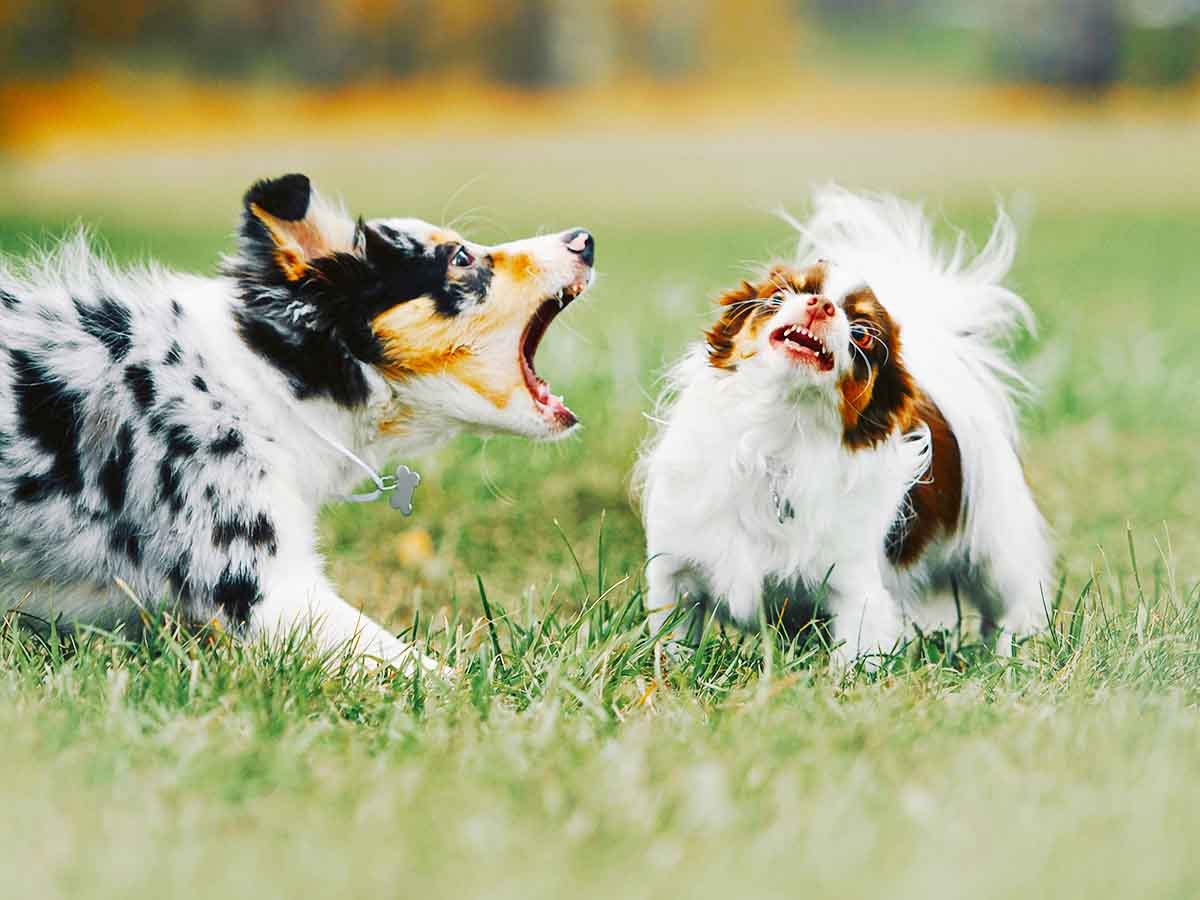
7. Why Do Puppies Bark at Other Dogs?
Your puppy may bark at other dogs on a walk or when it sees another dog passing the house.
Your puppy barks at other dogs because:
- It is defending its territory, either its home or its person.
- It is afraid of the other dog and barks to warn it to stay away.
- It is exciting to see the other dog, and your puppy wants to play.
You can take the same approach to barking at other dogs as you can to barking at humans:
- Distract your puppy before it starts barking at another dog.
- Walk in the opposite direction until your puppy calms down.
- Stand and persuade your puppy to sit quietly until the other dog goes past.
- Work with another dog owner to practice walking past another dog without barking.
Your puppy is young, and barking is one way it alerts you to its feelings.
You can support your puppy by teaching it not to bark at other dogs, and being quieter brings rewards.
8. Why Do Puppies Bark at Their Food?
Your puppy can bark at its food from:
- Defensiveness – your puppy is not barking at the food but you, the cat, or another dog because it fears losing its meal.
- Anxiety – your puppy may bark to make sure you come back and watch it eat because it feels vulnerable while eating.
- Surprise – if you have a shiny food bowl, your puppy may become spooked at its own reflection.
- Demand – perhaps your puppy is super hungry and wants its food NOW!
You can train your puppy not to bark at mealtimes by ensuring it has a safe place to eat without other pets potentially gaining access to its food.
A quiet corner where your puppy can eat in peace is usually best.
If your puppy barks to get you to give it the food faster, then train your puppy to sit quietly before you put the food bowl down.
Alternatively, put the food bowl down when the puppy is in another room before calling it for its meal.
9. Why Does Your Puppy Bark at You?
Your puppy barks at you because it tries to get a message across. To understand what your puppy’s barks mean, you need to observe its behavior and body language.
Your puppy can bark at you because:
- It is exciting to see you – barking with a wildly wagging tail and some excited jumps.
- It needs to go outside – the bark is probably relatively static with a meaningful look.
- It wants to play – tail wagging and perhaps a play bow.
- It doesn’t want you to leave it alone for the night or the day or the hour.
The key to understanding what your puppy’s barks mean is to spend time watching how and why your puppy barks.
Try and avoid rushing to see what your puppy is barking about because all that will do is teach your puppy that barking means “human come here.”
If the barking is a nuisance, you can train your puppy to be happy in its crate and greet you more quietly, but barking is an essential communication tool for your puppy, so you won’t ever have a non-barking puppy.
10. What If Your Puppy Bites as Well as Barks?
All puppies go through a biting and mouthing stage, but this usually passes when the puppy is five months old.
If the biting seems to be aggressive or territorial rather than mouthing, then that is an issue you want to address quickly before it becomes an ingrained habit.
Tail wagging usually means your puppy is playing, but ears back and tail down may show that your puppy is biting through fear.
If your puppy is biting through fear, it may need you to create a safe zone it can retreat to when afraid, or there may be something specific that triggers the puppy’s fear response.
Many puppies bark and bite vacuum cleaners, for example.
If you can find the fear trigger, you can desensitize your puppy to whatever is causing it to be afraid.
11. Why Does Your Puppy Bark at Your Children?
Your puppy can bark at your children for the same reasons it barks at you, but a different cause of your puppy barking at your children can be that your children encourage your puppy to bark.
Your children can unintentionally encourage your puppy to bark by producing loud noises (the puppy joins in) or taking the puppy’s toys and not giving them back.
Your children may also reward your puppy when it barks by rushing to see what it needs, playing a game or giving a treat to stop it barking, or only paying attention to the puppy when it barks.
As well as training your puppy to be well behaved, it would be best if you teach your children how to look after the puppy without encouraging it to communicate by shouting (barking).
12. Why Do Puppies Bark at Nothing?
It may seem that your puppy is barking for no reason, but your puppy only barks when it has something to say.
Your puppy’s hearing and sense of smell are more sensitive than yours, and your puppy may bark because it hears or smells another animal passing the house.
Your puppy may also bark because it is lonely or needs to go outside.
If your puppy is barking, then it is barking for a reason.
When you work out why your puppy is barking, you can decide if the barking is conversational or something you need to train away to restore peace.
13. Does Your Puppy Bark for Attention?
Your puppy definitely barks to get your attention.
Sometimes you need to reward your puppy’s bark with the attention it needs, and sometimes you need to withhold attention to teach your puppy that it can’t constantly bark to get you to rush to its side.
In the early days when your puppy comes home, you will probably reward all barking with attention because you are learning how to communicate with your puppy and settling it into its new home.
After a few weeks, you will have a routine for when your puppy needs a bathroom break and when it needs to sleep through the night.
When you establish a routine, you will want to ignore some barking for attention and substitute other calming measures like music or soothing scents to reinforce the times when your puppy needs to be quiet and by itself.
14. Does Your Puppy Bark When You Leave?
Many puppies suffer separation anxiety and bark when you leave to persuade you to either stay with them or take them with you.
Rather like dropping a crying child off at school, you have the impression that your puppy will do nothing but bark continuously while you are absent.
In practice, neither the child nor the puppy fusses after you are out of sight (with a few exceptions).
It is best to train your puppy to be happy by itself, either in a crate, playpen, or safe room when you leave by working up to more extended absences.
You can start with a five-minute absence, go into another room, and only come back when your puppy is quiet. Gradually, you increase the time away.
You can also prepare your puppy to spend time alone by ensuring that it is comfortable and a little sleepy – ensure your puppy has a bathroom break and some playtime and exercise before you leave.
This way, your puppy can recharge its energy with a power nap while you are gone.
15. Does Your Puppy Bark at Your Cat?
Your puppy may bark at your cat because:
- It doesn’t know what a cat is and is afraid.
- It sees the cat as a potential playmate and tries to attract attention.
You can train your puppy and cat to get along without barking.
The Woof Truth
Unless your puppy is from a non-barking breed, your puppy will bark to communicate.
If your puppy barks occasionally, you will probably not stress too much, but you may find the noise a nuisance if your puppy barks excessively.
Many of the reasons your puppy barks will resolve with maturity and training.
By the time your puppy is an adult dog, you will both understand what your puppy’s bark means, and you will appreciate your watchful friend alerting you to a knock on the door and expressing joy at your return from work.